
A voice AI agent that nails one demo call proves very little. The real question for a business is whether it gets the same call right on Monday morning, Friday afternoon and at 9pm on a Sunday. In November 2026, G2 and voice-AI testing company Bluejay published one of the first independent tests of exactly that: voice AI reliability across six of the best-known platforms. Here is what they found, and what it means if you are thinking about putting an AI receptionist on your phones.
How the test worked
Bluejay built three simulated businesses: a dermatology clinic, a law firm and an electronics retailer. Each had 30 realistic phone tasks, such as booking an appointment, running a new-client intake or handling a return. That made 90 tasks in total.
Six platforms were tested: LiveKit Agents, Pipecat, Retell AI, ElevenLabs Agents, Vapi and Bland. Every task was run five times on every platform, starting from exactly the same state each time.
The pass mark was strict. A call only counted as a success if the right thing actually happened in the business system: the appointment was booked, the record was updated, the hand-off reached staff. An agent that sounded confident but didn’t finish the job failed.
The headline results
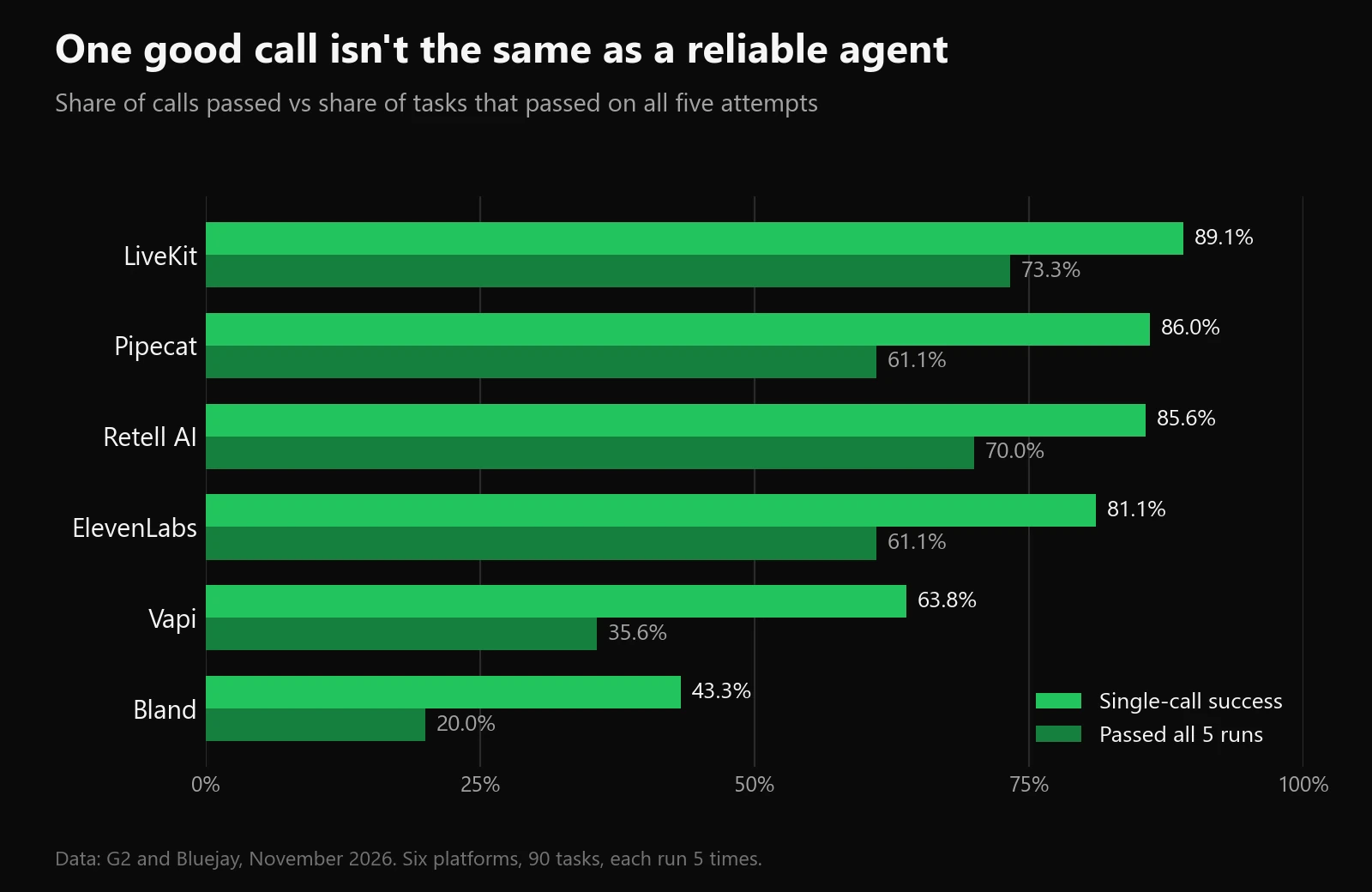
G2 reported two numbers for each platform. Single-call success is the share of individual calls that passed. Five-run consistency is the share of tasks that passed on all five attempts. The second number is the one that matters to a business, because it is the difference between “it usually works” and “it works”.
| Platform | Single-call success | Passed all 5 runs |
|---|---|---|
| LiveKit Agents | 89.1% | 73.3% |
| Pipecat | 86.0% | 61.1% |
| Retell AI | 85.6% | 70.0% |
| ElevenLabs Agents | 81.1% | 61.1% |
| Vapi | 63.8% | 35.6% |
| Bland | 43.3% | 20.0% |
Source: G2 and Bluejay, November 2026. Platforms tested at default settings in simulated environments.
LiveKit came out on top on both measures. On every platform, though, the five-run number was well below the single-call number, by 15 to 28 percentage points. In other words, plenty of tasks worked on some attempts and failed on others, even though nothing about the call had changed.
Lesson 1: one good test call proves nothing
This is the most useful finding for anyone buying voice AI. In one example from the report, the same law-firm call was run twice on the same platform. In one run the agent correctly handed the caller to staff. In the other, it told the caller the firm couldn’t help and hung up. Same caller, same script, different outcome.
The chart below shows how common this was. Every task was attempted five times. The bright green section is tasks that passed every time; everything to the right of it passed only sometimes, or never.
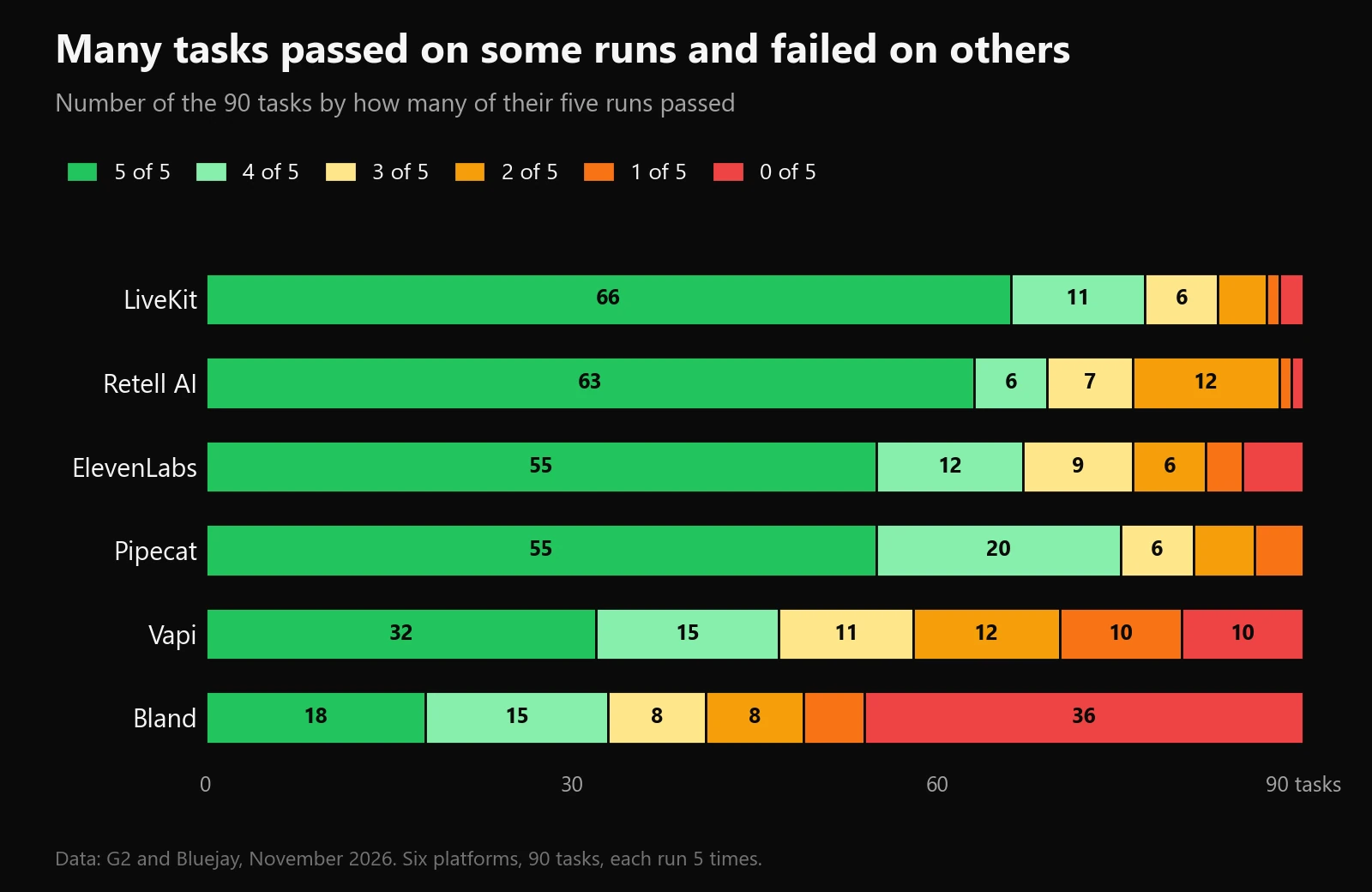
If you are trialling an AI receptionist, run your most important call types several times each, not once. If a vendor only ever shows you a single polished demo, ask how often that call succeeds when it is repeated.
Lesson 2: most failures are decisions, not hearing
Bluejay sorted every failed call (680 in total) by its cause:
- Wrong decision (55%): the agent heard the caller correctly but took the wrong action, such as skipping a required step.
- Mishearing (28%): a name, phone number or order number was transcribed wrongly.
- Platform faults (16%): the system mishandled the call, such as a booking that never reached the calendar.
- Audio output (0.3%): almost never a problem.
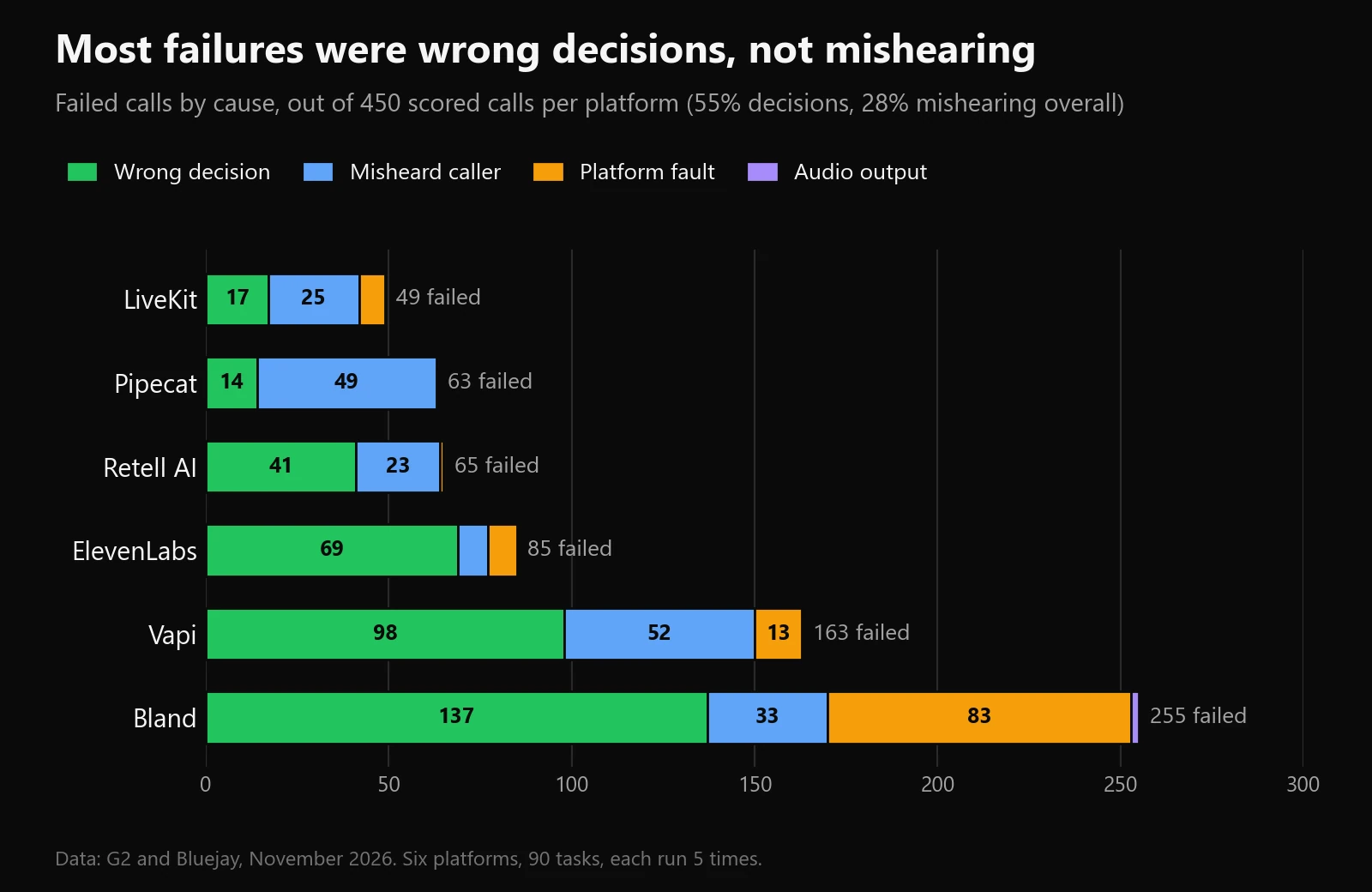
So the voice is rarely the weak point. What matters is how the agent is instructed, which steps it must follow, and whether the booking or message actually lands where it should. That is a build and testing problem, and it is why two businesses on the same platform can get very different results.
Lesson 3: check the result, not the conversation
A call can sound perfect and still fail. In one example from the report, an agent saved a caller’s phone number incorrectly, so the law firm had no way to call them back. Nobody listening to the call would have noticed.
During any pilot, check what ended up in your system after each test call. Was the appointment booked at the right time with the right person? Did the message reach the right inbox with a correct phone number? That is the only test that counts.
Lesson 4: phone line quality matters
Bluejay also re-ran a set of easy calls with traffic noise in the background, and again over a poor, choppy phone connection. Background noise made little difference on most platforms. A bad line was a different story: every platform passed fewer than about half of those calls. The testers noted that parts of the caller’s speech were hard to make out even with the best transcription tools.
The practical takeaway is that the phone connection is part of the system. A clean, local carrier connection gives an AI agent the best chance of hearing your callers properly, and it is worth testing with real names and numbers, not just easy ones.
What this means for Australian businesses
The report is a useful reality check. Voice AI is now good enough to handle the bulk of routine calls, and the best platform passed close to 9 in 10 calls. But reliability doesn’t come from the platform alone. It comes from how the agent is built, how thoroughly it is tested, and how closely its results are checked once it goes live.
That is how we work at Tronic. Our AI voice agents are built on LiveKit, the platform that topped this test, and we add the parts the test showed matter most:
- Repeated testing before every change. We run each important call type many times against a test copy of your agent before anything goes live, rather than trusting a single test call.
- Checking outcomes, not just transcripts. We confirm the booking, message or transfer actually reached your business, and a safety net can email your team if a caller’s request didn’t get through.
- Ongoing call reviews. We review real calls after each change to catch anything that has slipped.
- Australian phone network and hosting. Calls run over Australian phone connections, with servers and data hosted in Australia.
Frequently asked questions
Which voice AI platform was the most reliable in G2’s test?
LiveKit Agents had the highest results on both measures: 89.1% of individual calls passed, and 73.3% of tasks passed on all five attempts.
Why did the same call pass once and fail the next time?
AI models don’t always make the same choice twice, even with identical input. That is why repeated testing, clear instructions and checks on the final result matter more than any single demo call.
Do the results predict how an agent will perform in my business?
Not directly. The calls were simulated English-speaking callers who didn’t interrupt, and each platform ran at its default settings. A well-built and well-tested agent can perform differently from those defaults, for better or worse. Treat the report as a guide to what to test, not a final score.
How should I test an AI receptionist before I commit?
Run each of your key call types several times, use realistic names, phone numbers and details, include a call on a mobile with patchy reception, and check your calendar or inbox after every call to confirm the job was done.
Hear a reliable AI receptionist for yourself
The best way to judge an AI voice agent is to call one. Our AI voice agent page has real call recordings and a call-me-now demo. If you would rather build and run your own agent, Tronic Cloud Voice AI gives you the same LiveKit-based platform, hosted in Australia. Or call us on 1300 788 718 to talk it through.
Source: G2, “We ran the same 90 Voice AI tasks five times. Here’s what we learned about reliability”, November 2026, testing by Bluejay.